
How long does food stay fresh in MAP packaging with nitrogen?
In MAP packaging with nitrogen, food stays considerably fresher than in conventional packaging. Depending on the type of food, shelf life varies: meat typically stays fresh for 7-14 days, fish for 5-10 days, vegetables for 7-21 days, and fruit for 7-14 days. This technology effectively slows down oxidation and microbial growth by replacing oxygen with inert nitrogen gas. The exact shelf life depends on factors such as initial food quality, packaging integrity, temperature, and hygiene during processing. MAP packaging (Modified Atmosphere Packaging) with nitrogen is a preservation technique where the air in the packaging is replaced by a controlled atmosphere with a high concentration of nitrogen. This method reduces the […]
What compressors do you need for in-house nitrogen production?
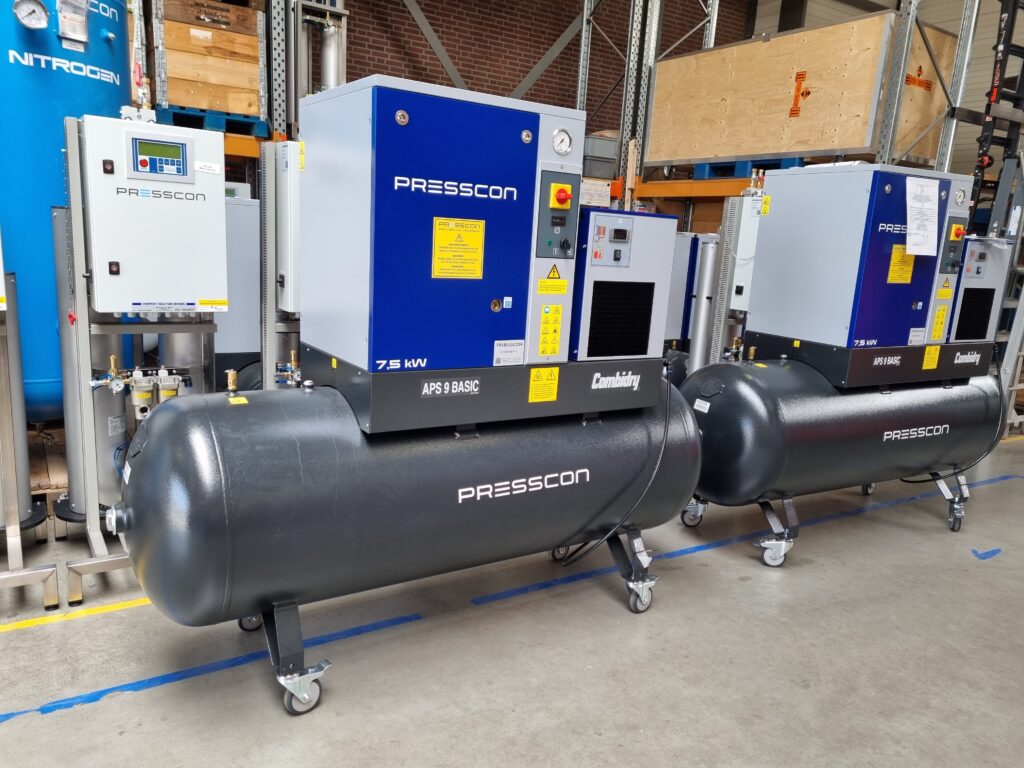
For in-house nitrogen production, you need various compressors depending on your application and production capacity.
What certifications does nitrogen require for food contact?
Nitrogen that comes into contact with food must comply with strict certifications to guarantee food safety. The most important certifications are ISO 22000, HACCP, and FSSC 22000, which ensure quality assurance and food safety. Additionally, food-grade nitrogen must meet specific purity requirements of at least 99.5% and be free from contaminants such as oil and moisture. European regulations, including the Food Contact Materials Regulation, also set requirements for gases that come into contact with food. These certifications ensure that nitrogen can be safely used in food production and packaging. Certifications for nitrogen in the food industry are essential because they ensure safety and quality […]
How do I monitor the gas composition in MAP packaging?
Monitoring gas composition in MAP (Modified Atmosphere Packaging) requires precise measuring equipment and systematic control procedures. You can check the gas composition using headspace analyzers that measure the percentage of oxygen, nitrogen and carbon dioxide. These measurements can be destructive (where the packaging is punctured) or non-destructive (via sensors). For effective monitoring, it is important to establish a regular testing schedule, use the appropriate equipment, and systematically document results to detect deviations early. Gas monitoring in MAP packaging is important because the correct gas composition directly determines shelf life, food safety and product quality. With modified atmosphere packaging, the […]
What are the safety risks of nitrogen in the food industry?
Nitrogen is widely used in the food industry for extending shelf life, improving product quality and creating inert environments. Although nitrogen itself is not toxic, its use brings specific safety risks. The main hazards are oxygen displacement (risk of suffocation), risks associated with the use of liquid nitrogen such as freezing, and pressure-related dangers during storage and transport. For safe use, adequate ventilation systems, oxygen monitoring, personal protective equipment and thorough staff training are essential. Nitrogen is applied in the food industry due to its unique properties that help maintain the quality and freshness of food products. As an inert gas, nitrogen is non-reactive […]
How do I test the quality of nitrogen for food packaging?
To test the quality of nitrogen for food packaging, you must check various parameters such as purity, oxygen content, and humidity. You can use specialized measuring equipment for this, including oxygen analyzers, dew point meters, and gas analyzers. For reliable results, it is important to test regularly according to a fixed schedule and follow the proper calibration procedures. Through systematic quality control, you ensure optimal food safety and maximum shelf life of packaged products. The quality of nitrogen plays a decisive role in maintaining food quality in packaging. In food packaging, nitrogen is used in Modified Atmosphere Packaging (MAP), where natural air is replaced by a controlled gas mixture. Nitrogen […]
What is a 300 bar high-pressure nitrogen battery?
A high-pressure nitrogen battery operating at 300 bar is a specialized storage system that compresses and stores nitrogen gas at a pressure of 300 bar (approximately 300 times atmospheric pressure). These systems serve as buffers for industrial processes that require continuous nitrogen supply, such as metal laser cutting, packaging processes, and laboratory environments. The 300 bar pressure ensures maximum storage capacity in compact pressure tanks. A high-pressure nitrogen battery operating at 300 bar is an industrial storage system that maintains nitrogen gas under high pressure for immediate availability in production processes. The system consists of robust pressure tanks specifically designed to safely handle the extreme pressure of 300 bar. This technology […]
How can nitrogen be produced using solar energy?
Nitrogen production using solar energy combines sustainable energy generation with advanced nitrogen generator technology. Solar panels generate electricity that drives compressors for nitrogen separation from air. This green nitrogen solution offers companies energy-efficient nitrogen production with lower operational costs and reduced CO2 emissions. Industrial demand for nitrogen is growing worldwide, while companies simultaneously pursue their sustainability objectives. Traditional nitrogen production requires significant energy and causes substantial CO2 emissions. Solar energy offers a revolutionary solution for energy-efficient nitrogen generation. This technology enables companies to produce their own green nitrogen without dependence on fossil fuels. Various sectors are discovering the advantages of solar-powered nitrogen systems. […]
What nitrogen pressure do you need for laser cutting?
For laser cutting, you need a nitrogen pressure of 8 to 25 bar, depending on the material and thickness.
Is laser cutting with nitrogen more expensive than with oxygen?
Yes, laser cutting with nitrogen is generally more expensive than with oxygen due to higher gas costs. However, nitrogen offers important advantages such as oxidation prevention and better cutting quality, which often results in lower total costs due to reduced post-processing requirements. An in-house nitrogen generator can significantly reduce these costs with regular use. The choice between nitrogen and oxygen in laser cutting processes not only determines your direct gas costs, but also affects the quality of the final product and the required post-processing. For metalworking companies and machine builders, this decision has a major impact on total production costs. Oxygen laser cutting works excellently for carbon steel and offers high cutting speeds at relatively low […]