

SKID: Nitrogen Generator for Laser Cutting
On site laser cutting system
A reliable nitrogen generator for laser cutting gives metal fabrication companies direct control over nitrogen purity, pressure, flow and availability. Instead of depending on cylinders or bulk nitrogen deliveries, the required nitrogen gas is produced on-site and available on demand.
During laser cutting, nitrogen acts as an assist gas. It removes molten metal from the cutting kerf while shielding the hot cutting edge from oxygen. This limits oxidation and helps create clean, bright edges, particularly when cutting stainless steel and aluminium.
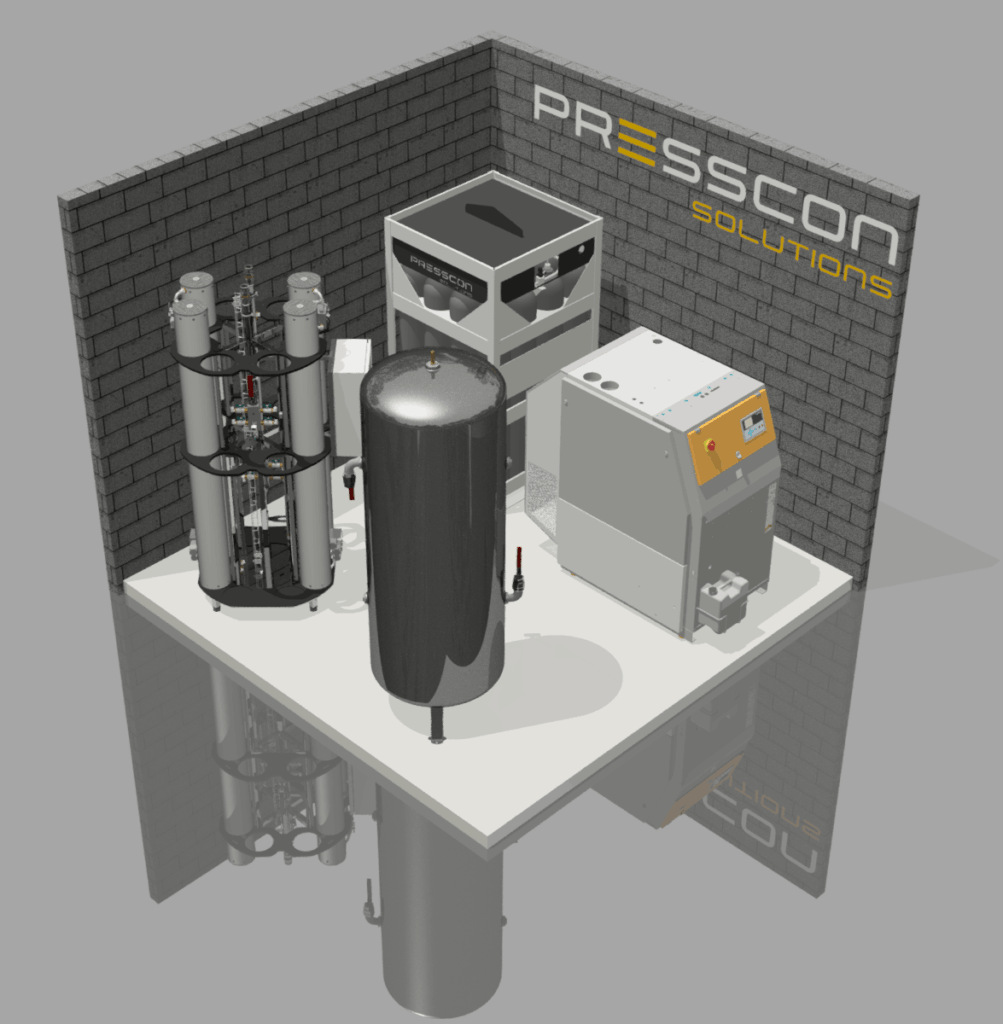
Presscon designs complete systems for nitrogen generation for laser cutting. A typical installation combines an energy-efficient air compressor, compressed air treatment, an HP-PSA nitrogen generator, a booster and high-pressure nitrogen storage. The complete system is engineered around the actual requirements of your laser cutting machines.
Why is nitrogen used for laser cutting?
A laser cutting machine uses a concentrated laser beam to heat, melt or vaporise metal along a programmed cutting path. At the same time, an assist gas flows through the laser cutting head.
When nitrogen is used as the assist gas, it performs two important functions. First, the nitrogen flow forces molten material out of the kerf. This allows the laser to continue cutting accurately through the material. Second, nitrogen displaces oxygen around the heated cutting zone. Because nitrogen is inert under normal cutting conditions, it does not support the oxidation reaction at the cut edge.
This is particularly important for stainless steel, aluminium and other materials where the surface condition after cutting matters. Excess oxygen can create oxide scale, discolouration and an edge that requires additional treatment before welding, painting or coating. The correct combination of nitrogen purity, pressure and flow therefore contributes directly to repeatable laser cutting quality.
A complete nitrogen generation system for laser cutting
Industrial laser cutting requires more than a standalone nitrogen generator. The complete gas supply must continuously deliver enough nitrogen at the purity, flow and pressure required by the laser.
A Presscon installation can include:
- An energy-efficient air compressor
- Compressed air filtration
- Compressed air drying
- Presscon N-Gen HP-PSA nitrogen generator
- Low-pressure nitrogen buffer
- Nitrogen booster
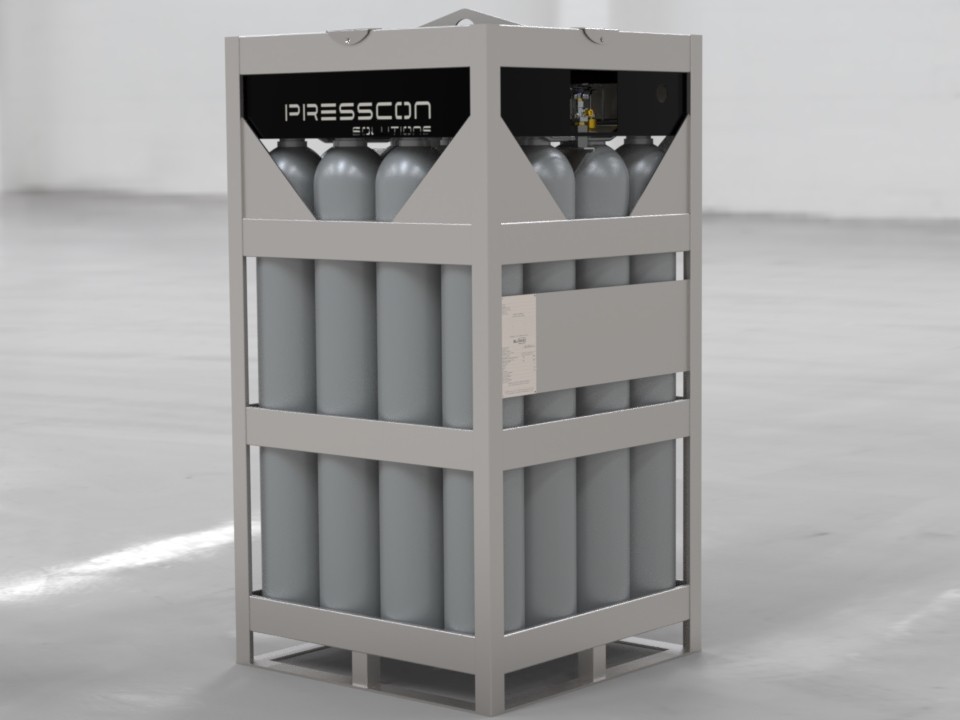
- High-pressure cylinder skid or storage system
- Pressure regulation
- Nitrogen purity monitoring
- Pressure and flow measurement
- System controls and optional remote monitoring
These components are engineered as one system. The compressor provides the compressed air required for nitrogen production. Air treatment protects the CMS inside the generator. The N-Gen separates oxygen from the compressed air, after which the produced nitrogen is buffered and compressed to the pressure required for storage and laser cutting. This integrated approach is important because nitrogen demand from a laser is highly dynamic. The generator, booster and storage system must be able to respond without compromising pressure or gas availability.
How does a nitrogen generator for laser cutting work?
Presscon uses High-Performance Pressure Swing Adsorption, or HP-PSA, for on-site nitrogen generation.
The process starts with clean and dry compressed air. The air compressor draws in ambient air and compresses it. Filters and air treatment equipment then remove moisture and contaminants before the compressed air enters the nitrogen generator. Inside the generator, compressed air flows through vessels containing Carbon Molecular Sieve, or CMS.
The CMS adsorbs oxygen molecules while nitrogen passes through the vessel. Once the CMS approaches saturation, the vessel is depressurised. The adsorbed oxygen is released, while another vessel takes over nitrogen production. This alternating cycle continuously produces nitrogen gas for the laser cutting process.
Presscon has further developed conventional PSA technology into HP-PSA. The system uses optimised airflow and a patented CMS compression system to improve the efficiency and service life of the nitrogen generator.
The HP-PSA design provides:
- Stable purity up to 99.9999%
- Longer CMS lifespan
- Stable nitrogen quality
- Efficient use of compressed air
- Modular capacity control
- Scalability for future expansion
- The possibility of system redundancy
The N-Gen can therefore be adapted to both current nitrogen demand and future growth in laser cutting capacity.
From compressed air to high-pressure nitrogen
Modern laser cutting applications often require more pressure than a standard nitrogen generator produces directly. For this reason, a complete Presscon nitrogen system can include a booster and high-pressure buffer storage. This configuration allows the nitrogen generator to produce gas efficiently, while the storage system handles sudden peaks in laser demand.
The process starts with ambient air. An energy-efficient air compressor produces compressed air, which is filtered and dried before entering the HP-PSA nitrogen generator. Proper air treatment is essential to protect the CMS and ensure reliable nitrogen production. Inside the generator, oxygen is separated from nitrogen, while the nitrogen flows into a buffer vessel.
Because laser cutting can require high pressure and large instantaneous gas flows, a booster increases the nitrogen to the required pressure before it is stored in a high-pressure cylinder skid. Depending on the system design, storage pressures can reach up to 300 bar. From the storage system, nitrogen is supplied to the laser at the required pressure and flow.
The complete process consists of the following stages:
- The air compressor generates compressed air.
- The compressed air is filtered and dried.
- The HP-PSA generator separates nitrogen from oxygen.
- The nitrogen is collected in a buffer vessel.
- A booster increases the nitrogen pressure.
- High-pressure nitrogen is stored until required.
- The laser receives nitrogen at the required pressure and flow.
This system architecture ensures a stable and uninterrupted nitrogen supply, even when laser demand changes rapidly. It also enables the generator, booster and storage system to be sized efficiently for the specific requirements of your production process.
- Modular design
- Low energy consumption
- Long lifespan
- Multifunctional use
High-pressure storage for peak nitrogen demand
The nitrogen consumption of a laser cutting machine is not constant. Demand changes according to material, thickness, nozzle configuration, cutting program and machine status. When several lasers are operating simultaneously, nitrogen demand can increase rapidly. A high-pressure nitrogen buffer absorbs these fluctuations.
Instead of sizing the nitrogen generator for every short-term consumption peak, nitrogen can be produced continuously and stored. When the laser suddenly requires a high flow, the stored nitrogen is immediately available. Correctly sizing the generator, booster and cylinder skid is therefore a critical part of the system design.
This provides several technical advantages:
- Stable supply pressure
- Sufficient nitrogen during peak demand
- Uninterrupted laser operation
- Efficient utilisation of generator capacity
- Reduced need for excessive generator oversizing
Nitrogen purity for laser cutting
The required nitrogen purity depends on the material, thickness, cutting parameters and desired edge quality. The Presscon N-Gen can produce nitrogen at purity levels ranging from 95% up to 99.9999% N₂. High purity nitrogen is particularly relevant when cutting stainless steel and aluminium. Remaining oxygen in the assist gas can react with the hot cutting edge and cause oxidation or discolouration.
Higher nitrogen purity reduces this reaction. However, the highest available purity is not automatically the most efficient choice for every application. Producing increasingly pure nitrogen generally requires more compressed air and therefore more energy. Presscon therefore determines the required nitrogen purity based on the actual process rather than automatically specifying maximum purity.
Laser cutting applications for on-site nitrogen
Nitrogen generation for stainless steel laser cutting
Nitrogen is widely used for stainless steel because it limits oxidation at the cutting edge. An oxide-free edge can reduce secondary treatment before welding, coating or further fabrication. This is particularly important for stainless steel components used in food-processing equipment and other applications where surface condition is critical.
Nitrogen generation for mild steel laser cutting
Nitrogen can also be used for mild steel when an oxidation-free edge is preferred. Where conventional oxygen-assisted cutting deliberately uses an oxidation reaction, nitrogen cutting avoids this reaction. This can be useful when components require a clean surface before painting, coating or welding.
Nitrogen generation for aluminium laser cutting
Aluminium is also sensitive to oxidation during thermal processing. High-purity nitrogen protects the cutting zone while the gas flow removes molten material from the kerf. Stable flow and pressure help maintain consistent edge quality across repeated production runs.
Nitrogen generation for sheet and tube laser cutting
Presscon nitrogen systems can supply both sheet-metal and tube-laser applications. When multiple machines use one central nitrogen supply, we calculate combined consumption and simultaneous peak demand to determine generator, booster and storage capacity.
Benefits of on-site nitrogen generation for laser cutting
On-site nitrogen generation gives laser cutting companies greater control over gas availability, quality and operating costs. The main benefits include:
Continuous nitrogen availability
Produce nitrogen directly at your facility and on demand, without waiting for cylinder or bulk deliveries.
Independence from external gas suppliers
Reduce dependency on external suppliers, delivery schedules and fluctuations in nitrogen costs.
Reduced nitrogen logistics
Minimise cylinder handling, bulk storage, rental charges, deliveries and gas supply planning.
Stable process conditions
Consistent nitrogen purity, pressure and flow support repeatable cutting quality and reliable production.
Determining your nitrogen requirements and calculating your ROI
Every laser cutting operation has different nitrogen requirements, which is why Presscon does not offer a standard solution based on general assumptions. We help you with every step of the process, from determining the required nitrogen purity, flow and pressure to selecting the right compressor capacity, HP-PSA nitrogen generator, booster and high-pressure storage volume. To design the most suitable installation, we analyse your complete production process.
We calculate the expected lifetime costs and potential savings. This gives you a realistic indication of the expected payback period. The result is a complete, future-proof nitrogen installation designed around your production requirements, with Presscon supporting you throughout the entire process from initial analysis and system design to installation, service and optimisation.
Presscon nitrogen generators for laser cutting
Presscon develops complete nitrogen systems rather than supplying only a standalone nitrogen generator.
This allows the air compressor, air treatment, nitrogen generation system, booster, high-pressure storage and controls to be engineered around the same process requirements.
The Presscon N-Gen is modular and can be installed in different configurations depending on available space and required capacity.
When required, multiple generator modules can also provide redundancy. Individual units can be isolated for maintenance while other modules remain operational.
With more than 25 years of experience in nitrogen technology, Presscon designs and manufactures its systems in-house in the Netherlands. Technical support and 24/7 service are available for industrial installations.
Why choose Presscon for laser cutting with nitrogen?
- Custom-built systems: designed to your specifications and fully assembled in our own factory.
- Energy-efficient operation: HP-PSA technology delivers significant cost savings and sustainability benefits.
- 24/7 service: Dedicated support and fast on-site response to minimize downtime.
- Global supply capability: Serving customers worldwide, from local SMEs to multinational corporations.
Questions about nitrogen solutions
Presscon specializes in the design, construction and maintenance of nitrogen expansion systems, fire prevention systems and innovative solutions using compressed air and nitrogen. Want to know more? Contact Presscon for more information.
Frequently asked questions about nitrogen generators for laser cutting
How much does a nitrogen generator for laser cutting cost?
The cost of a nitrogen generator for laser cutting depends on the required nitrogen flow, purity, pressure and storage capacity. The number and type of laser cutting machines also influence the system design. A complete installation may include an air compressor, air treatment, HP-PSA nitrogen generator, booster and high-pressure storage. Presscon therefore calculates the system and expected ROI based on your actual production requirements rather than using a standard price.
How much nitrogen does a laser cutter use, and what purity is needed?
Nitrogen consumption depends on factors such as material type, material thickness, nozzle configuration, cutting pressure and production time. The required purity also varies by application. Stainless steel and aluminium generally require high-purity nitrogen when a clean, oxidation-free edge is required. Presscon N-Gen systems can produce nitrogen at purity levels up to 99.9999%.
How do you size a nitrogen generator for a laser cutting application?
Correct sizing requires more than determining the maximum nitrogen flow of the laser. Presscon analyses average consumption, peak demand, operating pressure, required purity, production hours and simultaneous use of multiple machines. These parameters determine the required compressor capacity, HP-PSA generator size, booster capacity and high-pressure storage volume.
How does on-site nitrogen generation compare with bulk or bottled nitrogen?
Bulk and bottled nitrogen are produced externally and transported to your facility, making your production dependent on deliveries, storage and external gas prices. With on-site nitrogen generation, nitrogen is produced from compressed ambient air directly at your facility. This reduces transport and handling while giving you greater control over production capacity and nitrogen availability.
Can one nitrogen generator supply multiple laser cutting machines?
Yes. One central nitrogen generation system can supply several laser cutting machines. The system must be sized according to their combined nitrogen consumption and simultaneous peak demand. High-pressure storage can provide additional capacity during short consumption peaks, while the modular N-Gen configuration can be expanded as production grows.
What are the maintenance requirements for a nitrogen generator?
Maintenance focuses on maintaining reliable air quality and consistent nitrogen production. Depending on the installation, this includes servicing filters, dryers, compressors, valves, sensors and other system components. Proper compressed air treatment is particularly important for protecting the CMS inside the HP-PSA generator. Presscon’s modular design also allows individual generator modules and components to be serviced without automatically replacing the complete system.