

Protection of Heating Systems in Greenhouse Horticulture
A reliable heating system is essential for business continuity for growers in the greenhouse and horticulture sectors. Oxygen, magnetite, and changes in pressure and volume damage pipes, pumps, and heat exchangers. This leads to corrosion, malfunctions, and unplanned downtime. Presscon protects heating systems through degassing, partial-flow filtration, and nitrogen-controlled pressure and expansion regulation. With over 30 years of experience in the greenhouse and horticulture sectors, as well as in-house engineering and manufacturing, we provide customized solutions.
Need advice for your business or industry?
What risks can threaten a heating system?
A heating system in greenhouse horticulture is constantly exposed to factors that negatively affect its performance and service life. The three main risks are oxidation (corrosion), contamination, and disturbances in water quality, such as pH fluctuations and oxygen strike. If left uncontrolled, these factors lead to wear and tear, blockages, and ultimately malfunctions or system failure.
Corrosion Protection in Heating Systems
When oxygen comes into contact with steel pipes, fittings, and heat exchangers, corrosion occurs. This process damages the material and, over time, leads to a weakened system and leaks.
An important factor here is the water’s pH level. If the pH is too low, the steel becomes particularly susceptible to corrosion. By actively treating the water and maintaining a stable pH level of approximately 9, corrosion is significantly inhibited.
In addition, limiting oxygen ingress is essential. This is achieved through degassing and minimizing air ingress into the system. By systematically removing oxygen from the water, the root cause of oxidation is addressed, and the system’s service life is significantly extended.
Protection Against Contamination in Heating Systems
Corrosion and mechanical wear cause small iron-containing particles to form in the system. These particles, also known as magnetite, spread through the system via the water.
Magnetite is a major source of contamination and has a direct impact on the operation of components. It accumulates in pumps, valves, and heat exchangers, leading to reduced efficiency, increased wear, and higher energy consumption.
To prevent this, a bypass filter is used. This filter continuously draws a portion of the water from the system and uses magnets to remove the magnetite particles. This keeps the system clean and ensures that critical components continue to function optimally.
In addition to magnetite, coarser contaminants can also enter the system in specific situations, such as during construction or renovation work. Examples include sand, soil, or other external particles. In such cases, filter bags (with a pore size of approximately 25 to 1 micron) can be used to effectively capture these contaminants as well.
How Presscon Protects Heating Systems
Presscon combines three technologies to provide optimal protection for heating systems:
Removing oxygen through vacuum degassing
Dissolved gases are continuously removed from the water, which helps prevent corrosion.
Removing magnetite and contaminants via partial-flow filtration
Some of the water is filtered, effectively removing magnetite and other particles.
Maintaining Stable System Pressure Using a Nitrogen Expansion System
The pressure remains constant, and oxygen ingress is prevented.
What is a PSA nitrogen generator?
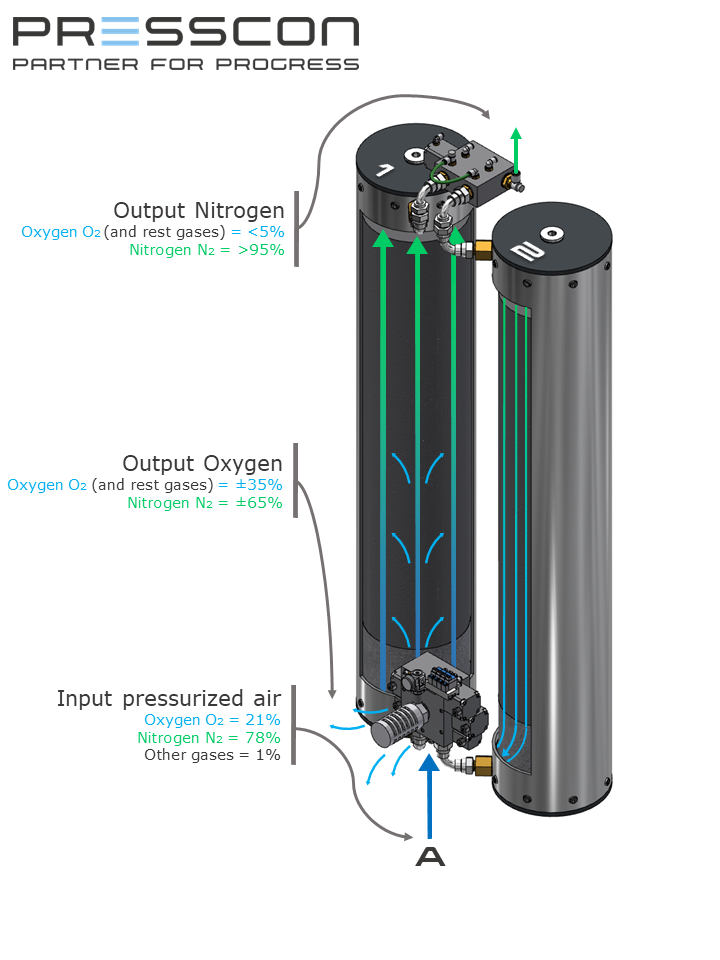
A PSA nitrogen generator is a system that produces high-purity nitrogen gas on-site from compressed air using PSA (Pressure Swing Adsorption) technology. This method takes advantage of the natural composition of air—approximately 78% nitrogen and 21% oxygen—and uses a special material called a Carbon Molecular Sieve (CMS) to selectively trap oxygen molecules under pressure. While the oxygen is adsorbed, the nitrogen passes through and is collected as a clean, dry gas. This nitrogen is used for pressure regulation and as a protective gas layer (nitrogen blanket) in the buffer tank.
Solutions for Protecting Heating Systems
- Filtering with very powerful magnets
- Visualize contamination with pressure gauges
- Automatic alarms and pressure switching
- Easy to connect to pump systems
ExitOxy Vacuum Degasser
The ExitOxy removes dissolved oxygen and gases from the heating water. This reduces the likelihood of rust formation. The system operates continuously, can be programmed using a timer, and is easy to install thanks to its plug-and-play design.
- Filtering with very powerful magnets
- Visualize contamination with pressure gauges
- Automatic alarms and pressure switching
- Easy to connect to pump systems
- Multiple partial flow filters in one system
- Automatic alarms and pressure switching
- Easy to connect to pump systems
- Visualize contamination with pressure gauges
Partial-flow filter and partial-flow filter units
These filters remove magnetite and suspended iron particles using powerful magnets. Pressure gauges make contamination visible, and an automatic alarm system ensures timely maintenance. The units are suitable for larger installations or multiple filter configurations.
- Monitor and control air pressure
- Keeps the pressure constant
- Efficient nitrogen cap
- Measure water levels
- ELC – SLC Buffer Tank Measurement
- PLUG & PLAY installation
- Monitor and control air pressure
- Keeps the pressure constant
- Efficient nitrogen cap
- Measure water levels
- Adjustable to desired blow-off pressure
Nitrogen Expansion System (Vernit & Hornit)
These systems regulate the pressure and monitor the water level around the buffer tank. They consist of a nitrogen generator using HP-PSA technology, a compressor, sensors, and a control module. Vernit is suitable for vertical buffer tanks, and Hornit is suitable for horizontal buffer tanks. With the Equal Level Control (ELC), multiple heating systems can be linked together to ensure an even distribution of water.
- +25 years of experience in compressed air
- Own innovation and production department
- Custom
- Sustainable and energy-efficient solutions
- Moves heat between storage tanks
- Ensures equal mass in storage tanks
- Can determine fluid direction
Buffer Tank Protection with Nitrogen
Above the water level in the buffer tank is an expansion space where pressure fluctuations occur. A controlled nitrogen blanket protects this space from oxygen ingress and helps maintain stable pressure. Learn more about buffer tank protection with nitrogen.
Long-Term Protection for Heating Systems
A well-protected heating system directly contributes to a longer service life and reliable operation of the system. By providing better protection for pipes, pumps, fittings, and heat exchangers, wear and tear is reduced, and parts need to be replaced less often. This also minimizes the risk of malfunctions and unplanned downtime.
Energy consumption also plays an important role here. Presscon’s HP-PSA technology is designed for efficient compressed air consumption during nitrogen production. In addition, the systems have a modular design, making it easy to perform maintenance and replace individual components. The systems are engineered and manufactured at Presscon’s own factory in Honselersdijk, allowing them to be tailored specifically to the technical requirements of the heating system.
Presscon as a partner for buffer tank protection
Presscon is an experienced partner in the field of buffer tank protection and has more than 30 years of expertise in compressed air, nitrogen, and expansion systems. All systems are designed, assembled, and tested in-house, ensuring high quality and reliability.
Presscon’s strength lies in providing an integrated solution. Nitrogen generators, pressure control, level monitoring, and safety components are combined into a single, complete system that works together optimally.
Each installation is tailored to the specific situation, including:
- Vertical or horizontal tank configuration
- Tank Capacity and Expansion Space
- Workload and Safety Limits
- Desired nitrogen capacity
- Water Level and Temperature Range
- Integration with existing control systems
- Desired Monitoring and Alerts
Why choose Presscon?
- Integrated protection: degassing, filtration, and nitrogen-controlled pressure regulation
- Custom Solutions for Existing and New Installations
- Less corrosion, magnetite, and unplanned downtime
- In-house engineering and manufacturing in the Netherlands
- Energy-Efficient HP-PSA Technology
- 24/7 service and technical support
Questions about nitrogen solutions from Presscon
Presscon specializes in the design, construction, and maintenance of nitrogen expansion systems, fire prevention systems, and innovative solutions using compressed air and nitrogen. Would you like to learn more? Contact Presscon for more information.
Frequently Asked Questions
How does magnetite form in a heating system?
Magnetite is formed as a result of wear and corrosion of metal pipes, which releases small iron particles that spread throughout the system.
How is oxygen removed from a heating system?
This is done through vacuum degassing, a process in which dissolved gases are continuously removed from the water.
What is the difference between degassing and partial-flow filtration?
Degassing removes dissolved gases such as oxygen, while partial-flow filtration removes solid particles such as magnetite from the water.
What is the function of a nitrogen expansion system?
The system maintains a constant pressure and prevents oxygen ingress by using nitrogen.
What does Equal Level Control (ELC) do?
ELC ensures an even distribution of water among connected buffer tanks and systems.
Can Presscon optimize an existing heating system?
Yes, existing systems can be modified and improved with degassing, filtration, and pressure control.