

Biological pest control
Controlling microorganisms biologically with nitrogen
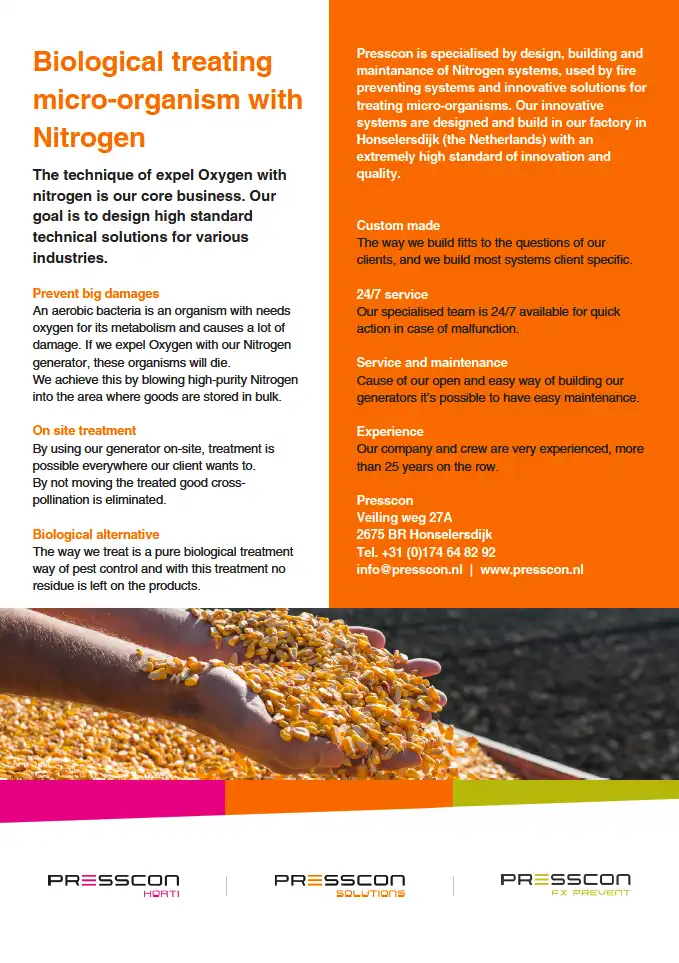
Agricultural and food products such as bulbs, seeds and consumer goods are often vulnerable to microorganisms and pests. Gall mites, narcissus mites and wireworms are notorious for causing severe damage, leading to product loss, reduced quality and financial setbacks. These organisms are aerobic, they rely on oxygen for their metabolism. Without oxygen, they cannot survive.
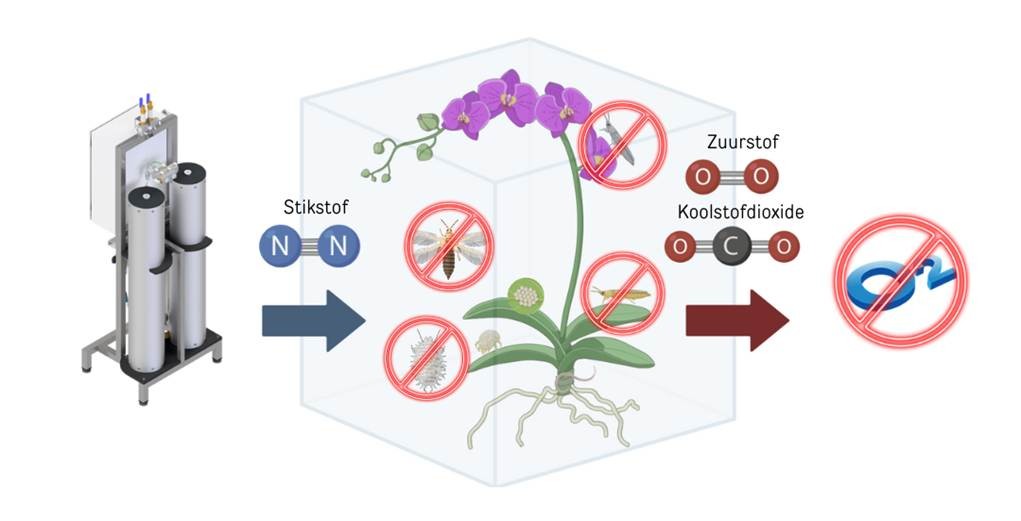
Presscon provides a sustainable and highly effective solution: biological pest control with nitrogen. By displacing oxygen with nitrogen in a controlled environment, we create conditions in which harmful pests and microorganisms cannot survive, without the use of chemicals or toxic residues.
Need advice for your business or industry?
How it works: removing oxygen for professional pest control
The principle behind our technique is simple yet powerful:
- Pests and microorganisms require oxygen to survive.
- By flushing an airtight room with high-purity nitrogen, the oxygen level drops rapidly.
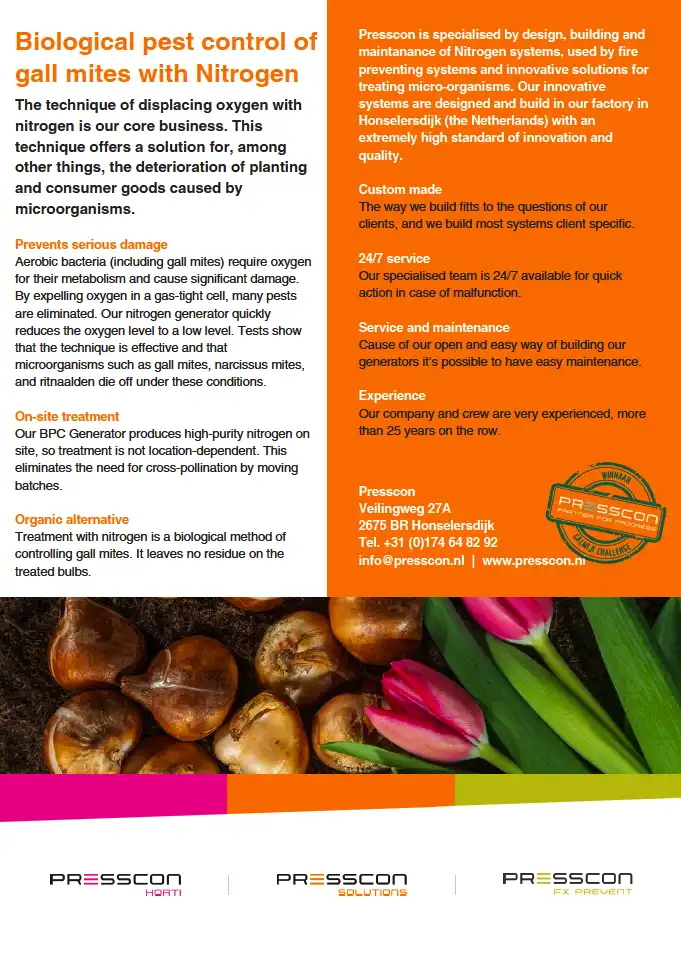
- Under these low-oxygen conditions, pests such as gall mites, narcissus mites and wireworms are unable to survive and die off.
The Presscon BPC-Gen is an advanced ULO pest control system designed specifically for on-site nitrogen generation. Creating ultra-low oxygen (ULO) is a proven, effective and sustainable method of pest control. With this system, the required nitrogen can be produced on-site and in the right purity.
On-site treatment, without cross-contamination
One of the key advantages of Presscon’s nitrogen-based pest control is that it can be applied directly at your site. Because nitrogen is generated on location, products no longer need to be moved for treatment. This prevents cross-contamination between different batches and eliminates logistical risks.
The treatment is not tied to a specific storage facility or region: it can be applied wherever your goods are stored.
A biological and residue-free alternative
Unlike chemical pesticides or fumigation, nitrogen treatment is completely natural and safe. Nitrogen is an inert gas that makes up 78% of the air we breathe. During treatment, it simply expels the oxygen in the environment.
This offers several advantages:
- Fully compliant with increasing demand for sustainable and organic production methods.
- No chemical residues on your products.
- Safe for humans and the environment.
By choosing nitrogen treatment, you not only protect your goods but also strengthen your company’s commitment to sustainability and environmentally friendly practices.
Proven benefits of nitrogen pest control
Presscon specializes in the design, construction and maintenance of nitrogen expansion systems, fire prevention systems and innovative solutions using compressed air and nitrogen. Below is an overview of the benefits of our nitrogen solutions:
- On-site treatment: No need to transport products, eliminating cross-contamination risks.
- Biological solution: Nitrogen is natural, safe and leaves no residues.
- Flexible and scalable: Systems are modular and adapted to your specific needs.
- Sustainable technology: Our HP-PSA nitrogen generation saves up to 40–50% energy compared to conventional systems.