

How can I apply remote monitoring to my gas systems?
Remote monitoring of gas systems enables you to monitor and manage your nitrogen and compressed air installations from a distance, giving you immediate insight into the status of your systems without being physically present. By combining sensors and digital technology, critical parameters such as pressure, temperature, and gas consumption are continuously measured and made available through a secure connection. For breweries, this means you can immediately detect gas-related problems like CO2 leaks, preventing production downtime and saving costs. With proper implementation, you transform your traditional gas systems into a smart, proactive infrastructure. Remote monitoring of gas systems is a technological […]
What is the ideal gas pressure for different beer styles?
The ideal gas pressure for beer varies greatly depending on the beer style, with lagers and pilsners typically requiring a CO2 pressure of 1.0-1.4 bar, while ales perform optimally between 0.8-1.2 bar. Stouts and porters often need a higher pressure (1.2-1.5 bar) and are regularly pressurized with a nitrogen/CO2 mixture to achieve their characteristic creamy texture. The perfect gas pressure is determined by factors such as carbonation level, temperature, line length, and height difference. A correctly set gas pressure ensures the ideal foam head, flavor experience, and mouthfeel appropriate for each specific beer style. The proper gas pressure is essential for preserving the characteristic properties of each type of beer. When dispensing […]
What nitrogen generator capacity do I need for my brewery?
To determine the right nitrogen generator capacity for your brewery, you need to consider various factors such as tank volume, number of tanks, frequency of use, and desired nitrogen purity. For a small craft brewery, a system of 1-5 Nm³/hour is typically sufficient, while medium-sized breweries need 5-20 Nm³/hour. Larger production facilities may require 20+ Nm³/hour. A professional calculation takes into account your specific brewing processes, peak production times, and future expansion plans. The correct nitrogen generator capacity is essential for an efficient and reliable brewing process. A system that’s too small can lead to production delays and quality loss, while a system that’s too large results in unnecessarily high investment costs and energy consumption […]
Why Switch from CO2 to Nitrogen in Beer Production?
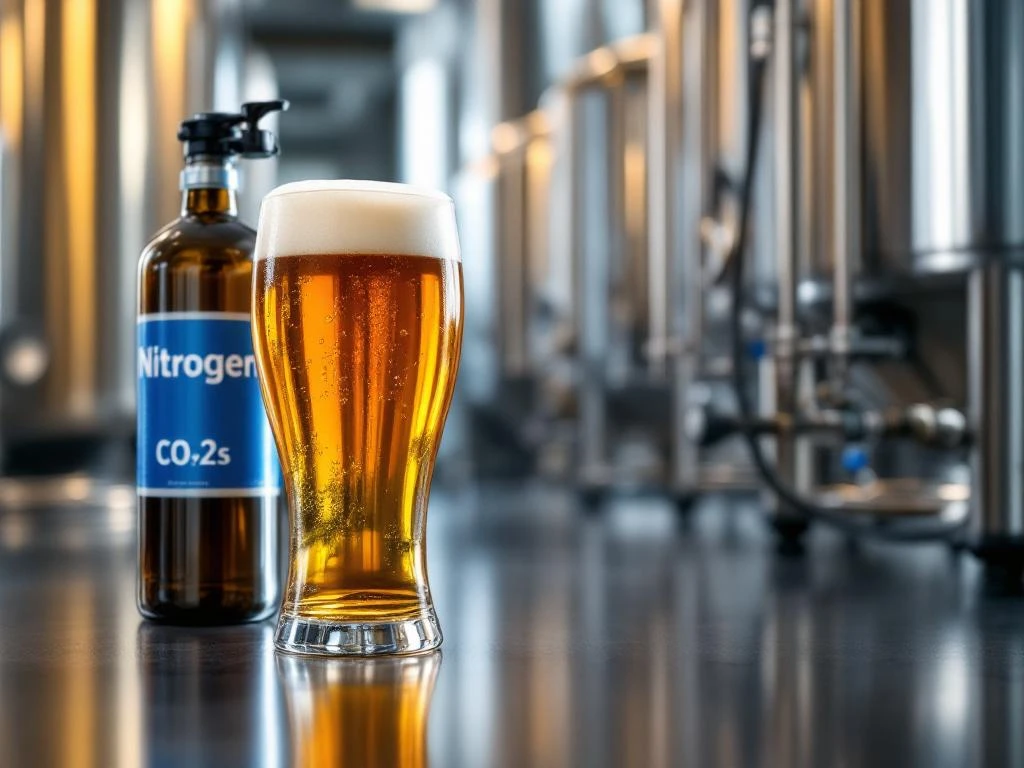
The transition from CO2 to nitrogen in beer production offers several significant advantages for breweries. Nitrogen is an inert gas that is less soluble in beer than CO2, resulting in reduced impact on flavor and quality. By using nitrogen, you can save costs, make your process more sustainable, and improve the quality of your beer. With an on-site nitrogen generator, you produce the gas locally, leading to decreased dependence on external suppliers and a lower CO2 footprint. This technological innovation aligns with the growing trend of efficiency and sustainability in the brewery sector. The beer brewing industry traditionally uses CO2 for […]