

Nitrogen solutions for fire prevention in museums
The best fire prevention for museums
Works of art, historical documents and cultural collections are invaluable and at the same time extremely vulnerable. Exposure to both light and oxygen can damage fragile materials and cause irreversible damage. Oxygen is an insidious enemy: it accelerates degradation, facilitates oxidative processes and also increases the risk of fire in archives and depots.
Presscon helps museumsa effectively manage these risks with proven nitrogen solutions for fire prevention. By creating low-oxygen environments and applying nitrogen blankets, fire risks are significantly reduced.
As a specialist in nitrogen generation for museum applications, Presscon offers reliable customized solutions based on proven technology. This allows museums to safely protect their valuable collections, today and for future generations.
Need advice for your business or industry?
Why oxygen is a risk for museums
In a museum environment, oxygen plays a larger role than is often thought. While essential for life, it simultaneously poses a serious risk to both building safety and the preservation of collections. In fact, oxygen causes two fundamental problems: increased fire risk and accelerated material degradation.
First, there is the risk of fire. Materials commonly found in museums (such as paper, cardboard, wood, textiles and preservation fluids) are naturally highly flammable. In archives and depots, these are often stored densely in a dry atmosphere, further increasing the fire risk. On top of that, many museums are located in historic buildings with outdated electrical systems, which significantly increases the risk of short circuits and fire. In an environment with normal oxygen levels, even a small spark can be enough to start a fire and spread rapidly.
In addition, oxygen directly affects the condition of collections. It accelerates oxidative processes that lead to discoloration, weakening and out such as paintings, paper, textiles and photographic materials. This process is often invisible but continuous.
The solution lies in the controlled lowering of oxygen levels using nitrogen. Nitrogen is an inert gas that occurs naturally in the air and has no harmful effects on objects or spaces. By partially displacing oxygen, a low-oxygen environment is created in which fire is significantly inhibited.
The result is a safe and sustainable museum environment that combines multiple benefits:
- Cost reduction and operational efficiency: reduced dependence on gas suppliers, lower energy costs and predictable operational expenses.
- Increased product quality and process stability: less oxidation, cleaner processes and consistent product properties.
- Safety and reliability: reducing fire and explosion risks, supporting ATEX safety and a more stable production environment.
By actively controlling oxygen with nitrogen technology, museums can minimize risk and significantly improve the safety of their collections.
How do nitrogen solutions work in a museum?
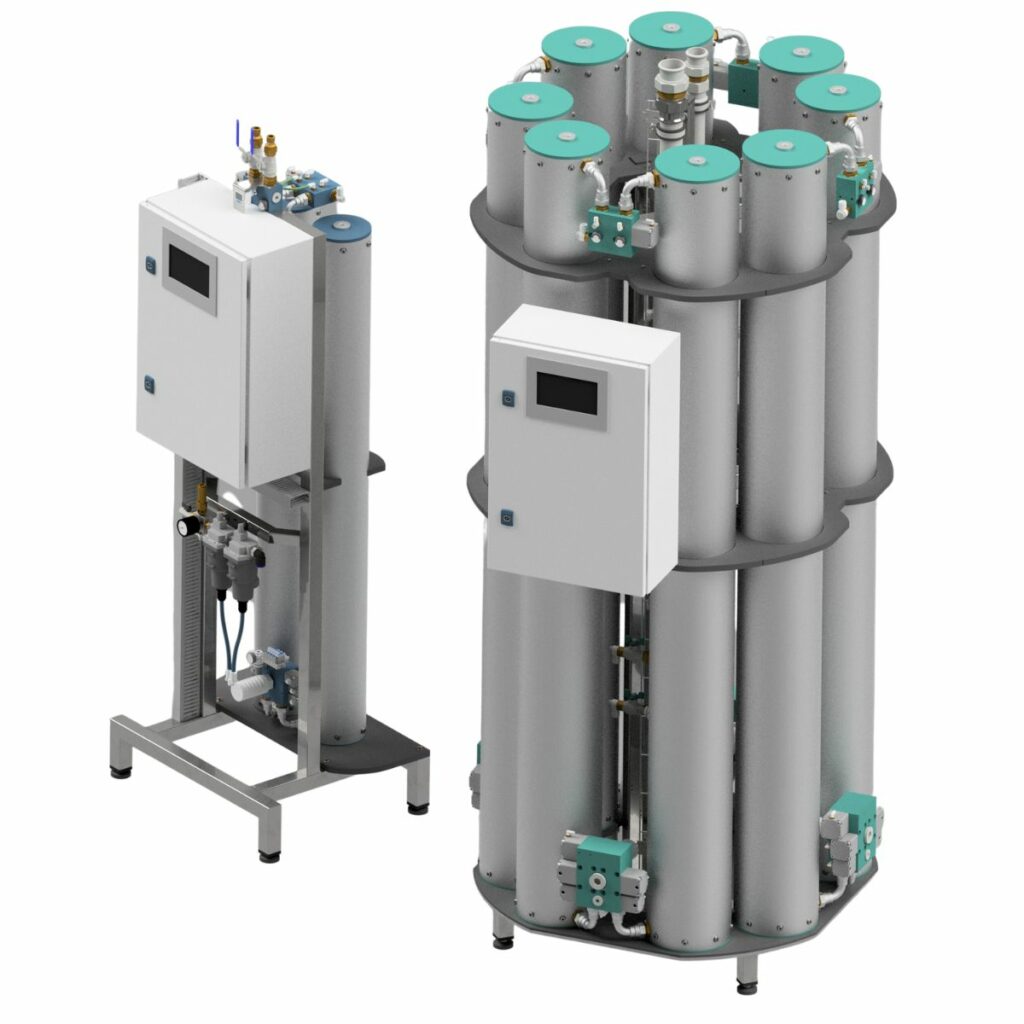
Nitrogen solutions in museums are based on advanced technology that generates nitrogen locally (on-site) and deploys it in a controlled manner to reduce oxygen levels. Presscon uses High Pressure Swing Adsorption (HP-PSA) technology for this purpose, a proven and efficient method of extracting nitrogen from ambient air.
The process begins with a compressed air system. Ambient air is drawn in and compressed, then passed under high pressure through a special filter medium: the Carbon Molecular Sieve (CMS). This material has the ability to adsorb (temporarily hold) oxygen molecules, while nitrogen molecules can flow freely. The result is a continuous flow of pure nitrogen that is immediately available for use.
This nitrogen is then used in various applications within the museum:
- Oxygen reduction in confined spaces such as archives and depots
- Nitrogen blanketing in display cases and storage cabinets
- Pressure control in hermetically sealed systems
The system operates fully automatically and is linked to oxygen sensors that continuously measure O₂ levels. Based on this real-time data, the nitrogen supply is precisely regulated. This keeps the oxygen level stable within preset limits, without manual intervention.
This integration provides a safe, efficient and low-maintenance solution that perfectly matches the requirements of museum environments.
Why nitrogen is essential for museums
Nitrogen plays a crucial role in ensuring safety within museums. Controlled lowering of oxygen levels creates an environment where fire risks are drastically reduced.
The main benefits of nitrogen in museums are:
- Reduces fire risk by permanently lowering oxygen levels
- Protects collections without the use of water, foam or chemicals
- Stabilizes air composition in depots and display cases
- Leaves no residue and causes no collateral damage to collections or building
These properties make nitrogen a durable and future-proof solution for museums that want to optimally protect their collections from fire.
Applications of nitrogen in museums
Nitrogen technology has several applications within museums, each aimed at minimizing risk and increasing safety.
Oxygen reduction in archives and collection depots
In archives and collection depots, an oxygen reduction system (ORS) can keep oxygen levels continuously below the ignition threshold. By reducing the oxygen level in a controlled manner below about 15%, fire cannot develop or propagate. Nitrogen is dosed automatically based on real-time sensor readings.
Nitrogen blanket in exhibition showcases
Individual exhibition cabinets can be provided with a controlled nitrogen atmosphere with a nitrogen blanket. This helps reduce risks such as oxidation and fire within enclosed environments.
Fire prevention in public areas, technical rooms and depots
In both public and technical areas, nitrogen can be used to structurally reduce oxygen levels. This actively prevents the outbreak of fire, rather than just detecting it. This is particularly valuable in areas with electrical installations or increased loads.
Inertization of hermetically sealed object cases and storage cabinets
For highly vulnerable objects, hermetically sealed crates or cabinets can be provided with an inert climate. By virtually eliminating oxygen, the risk of fire and deterioration is minimized.
Custom nitrogen solutions for museums
No two museums are the same. That is why Presscon provides fully customized nitrogen solutions to suit the specific requirements of the building and its users.
From design to realization, each system is matched to the existing infrastructure. Nitrogen generators are seamlessly integrated into building and climate systems, without disturbing existing processes. Depending on the application, nitrogen purity can range from 95% to as much as 99.9999%.
Presscon works closely with installers and structural engineers to develop solutions that are both technically robust and minimally invasive. With more than 30 years of experience and several patents, Presscon is a trusted partner for museums worldwide.
Sustainable nitrogen solutions for museums
Sustainability is playing an increasing role within the museum sector. Nitrogen solutions actively contribute to this by generating nitrogen locally without transportation or storage of gas cylinders.
In addition, these systems reduce the need for traditional extinguishing agents such as water or foam, which is not only more environmentally friendly, but also prevents damage to collections. Energy-efficient technologies and smart control keep energy consumption down.
The result is a sustainable solution that protects both the environment and cultural heritage.
Presscon: your partner in nitrogen for museums
Presscon is the specialist in nitrogen solutions for the museum sector. With in-depth knowledge of both technology and conservation, the company offers solutions that perfectly meet the unique challenges of museums.
From advice and design to installation and maintenance, Presscon guides the entire process and ensures a reliable and future-proof solution.
Why choose Presscon?
Museums choose Presscon for its combination of expertise, innovation and reliability. Some key reasons:
- More than 30 years of experience in nitrogen technology
- Specializing in museum applications
- Full customization and integration into existing systems
- Proven technology with patented solutions
- Focus on sustainability and energy efficiency
- International references and projects
Questions about nitrogen solutions in museums
Presscon specializes in the design, construction and maintenance of nitrogen expansion systems, fire prevention systems and innovative solutions using compressed air and nitrogen. Want to know more? Contact Presscon for more information.
Frequently asked questions about nitrogen in museums
How does an oxygen reduction system prevent fires in a museum?
An oxygen reduction system prevents fire in a museum by reducing the oxygen level in a controlled manner below the ignition limit of about 15%. Below this level, fire cannot develop or spread. The system works continuously and preventively: no fire needs to be detected before the system intervenes.
Does nitrogen damage artwork, documents or materials?
No, nitrogen does not damage artwork, documents or other museum objects. Nitrogen is an inert gas that does not react with organic or inorganic materials. The gas leaves no residue, does not affect humidity and does not attack surfaces. Nitrogen is therefore safe to use in rooms containing paintings, paper, textiles, metal and other fragile collection items.
Can a nitrogen plant be integrated into existing museum buildings?
Yes, a nitrogen system can be integrated into both new and existing museum buildings, including historic properties. The systems are modular and are custom designed for the specific building situation. Presscon analyzes the building’s layout, room density and ventilation structure before sizing an installation. This enables integration without major modifications to the existing building structure.
What is the difference between fire detection and fire prevention via nitrogen?
Fire detection responds only when there is already a fire, while nitrogen actively prevents fire by removing the conditions for combustion.
How energy efficient is a nitrogen generator in a museum environment?
A nitrogen generator for fire prevention in a museum operates energy efficiently because the system is continuously tuned to current demand. Presscon applies HP-PSA technology, which precisely controls compressed air consumption based on the measured oxygen level in the protected space. The system produces nitrogen only when needed to maintain the set oxygen percentage. This results in significantly lower energy consumption compared to systems with constant production capacity.
How we help museums move forward
For years we have been thinking about fire protection and improving conservation in museums. Whether you are looking for a completely new system, or are looking for improved quality; We help you move forward.