

Nitrogen
Gas Generator
Nitrogen is indispensable across industries for its inertness, dryness and consistency. Modern on-site nitrogen gas generators make it possible to produce exactly the purity and flow you need, around the clock, without the logistical effort and variability of cylinders or bulk deliveries. Below you’ll find a clear, in-depth overview of the technologies, products, applications and selection criteria that matter when choosing a nitrogen solution that fits your process.
What is a nitrogen generator and how does it work?
A nitrogen generator separates nitrogen from compressed ambient air and delivers it at a defined purity, pressure and flow. The most common and efficient method for on-site nitrogen production is Pressure Swing Adsorption (PSA). In this process, clean, dry compressed air passes through adsorption vessels filled with Carbon Molecular Sieve (CMS). Oxygen, moisture and carbon dioxide are captured in the CMS pores, while nitrogen passes through as the product gas. By alternating between pressurization and regeneration cycles, the system provides a continuous and stable nitrogen supply.
The exact purity and flow rate depend on the system configuration, air quality and process requirements. With proper design, PSA nitrogen generators deliver consistent performance and can be scaled to meet anything from small laboratory use to large industrial demand.
Need advice about nitrogen gas generators?
Pressure swing adsorption technology
PSA relies on two or more adsorption vessels filled with carbon molecular sieve (CMS). While one vessel adsorbs oxygen, moisture and CO₂ at elevated pressure, the other regenerates at lower pressure. The system alternates (or “swings”) between these states in short cycles, delivering a continuous nitrogen stream at the outlet. This cycling occurs at near-ambient temperature, which keeps the process energy-efficient and reliable.
Adsorption concept
In PSA, molecules with higher affinity to the adsorbent, primarily oxygen, are captured in the CMS pores. Nitrogen, with lower affinity and larger kinetic diameter, passes through. When pressure drops, the CMS releases the adsorbed gases to atmosphere, restoring capacity for the next cycle. Proper pre-treatment of the feed air (filtration and drying) protects the CMS and stabilizes purity.
How does PSA Gas Generation work?
The cycle consists of pressurization, adsorption, equalization and desorption steps. Instrumentation continuously monitors outlet purity (often via residual oxygen analysis) and adjusts cycle timing or flow to match demand. With correct sizing and air quality, PSA can achieve very high purities with stable, repeatable performance, even under varying loads.
Advantages of PSA nitrogen generation systems
PSA offers the widest purity range, typically 99.999% nitrogen. It provides excellent purity stability, traceable quality monitoring, and scales well from small workshops to large industrial plants. For applications like electronics, pharmaceuticals or laser cutting, PSA is often the most economical route to high purity at meaningful flow.
HP-PSA technology
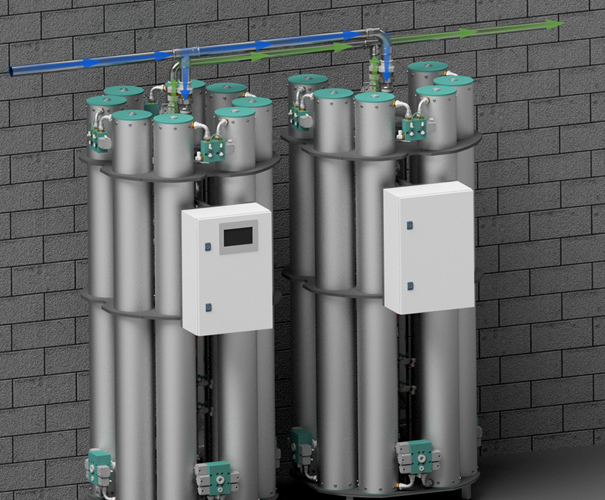
Presscon N-Gen uses HP-PSA technology. In this technique, separation of nitrogen and oxygen takes place by binding the oxygen molecules to a molecular carbon sieve: the Carbon Molecular Sieve (CMS). The major advantage of this technique is the fact that the amount of compressed air required for the same result is sometimes up to 40% lower.
Presscon N-gen is made up of multiple generators, allowing it to be tailored to your needs. The modular design allows the N-Gen to switch on and off by desired/requested capacity, based on pressure measurement or flow measurement. Presscon products are custom-made in our own development and production department in the Netherlands.
Industrial applications of nitrogen generators
Nitrogen gas generator in the food industry
Nitrogen protects freshness in modified atmosphere packaging, flushes headspace to slow oxidation, and provides hygienic, dry conditions during conveying and storage. Coffee degassing, meat packaging, bakery silo blanketing and wine bottling are common use cases where consistent purity and dry gas extend shelf life and preserve flavor.
Nitrogen generation in the pharmaceutical industry
Pharma facilities use PSA nitrogen for reactor blanketing, solvent storage, lyophilization support, and sterile packaging. Tight purity control and documented monitoring are central, as is adherence to cleanroom and data integrity expectations. On-site generation reduces supply disruptions and supports validation with continuous quality data.
Nitrogen generation in manufacturing companies
In manufacturing, nitrogen prevents oxidation in laser cutting, wave/reflow soldering and heat treatment, and provides inert atmospheres for additive manufacturing powder handling. It also balances tank volumes, reduces explosion risk in chemical processing, and purges piping during changeovers to accelerate turnaround safely.
Benefits of On-Site nitrogen generation
- Rapid return on investment: Eliminating deliveries, rental and boil-off typically yields payback in 6–24 months, depending on current gas spend, purity and operating hours. Modular systems let you add capacity as demand grows, preserving capital and further improving ROI.
- The convenient and safe alternative: On-demand generation avoids running out of gas, removes truck traffic and manual cylinder handling, and minimizes high-pressure inventory on site. Operations benefit from predictable supply and fewer logistics-related stoppages.
- Fits any application: PSA covers high purity and large flows, and polishers deliver ultra-high purity when required. With boosters, you can serve both low-pressure processes and high-pressure tools from the same platform.
Choosing the most reliable nitrogen generators
On-site nitrogen cuts operating costs, reduces emissions from deliveries, stabilizes quality at the point of use, and improves safety by lowering stored energy and cryogenic exposure—all while giving full control over purity, flow and pressure. With properly conditioned inlet air, generators deliver specified purity and flow continuously. Factory acceptance testing, on-site commissioning and ongoing monitoring underpin documented performance for regulated environments.
Benefits
- Modular skids simplify installation and future expansion.
- Integrated analyzers provide real-time purity verification.
- Smart controls match output to demand to reduce energy use.
- Quiet operation and compact footprints enable point-of-use placement to minimize distribution losses.
Questions about the nitrogen gas generators?
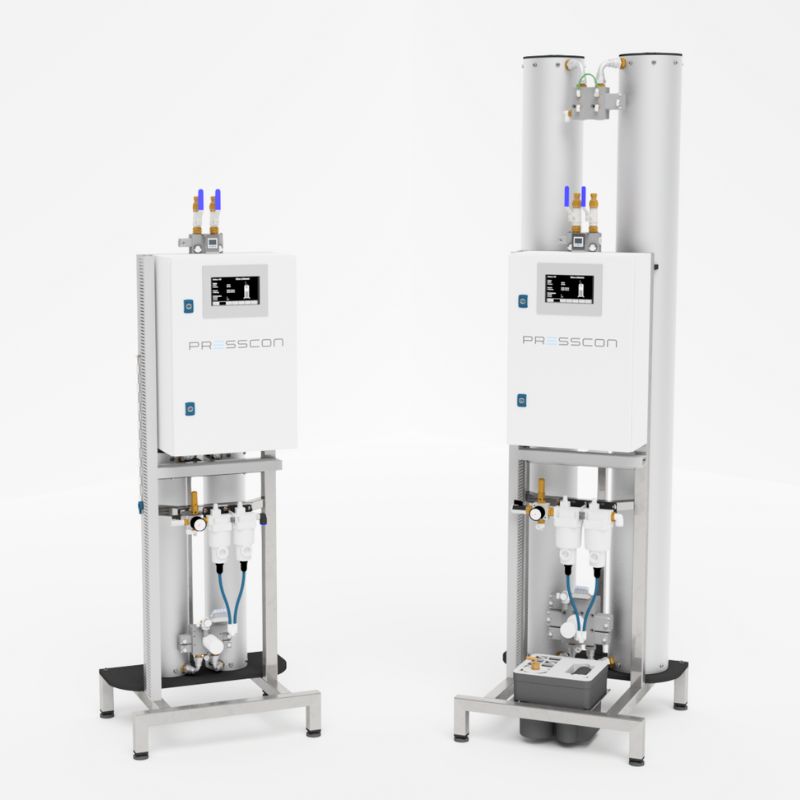
Presscon specializes in the design, construction, and maintenance of nitrogen expansion systems, fire prevention systems, and innovative solutions with compressed air and nitrogen. Want to know more? Contact Presscon for more information.
Frequently asked questions
How much does a nitrogen generator cost?
Capital cost depends on purity, flow and integration (dryers, filters, boosters). Operating cost is driven by electricity for air compression. A lifecycle cost comparison with delivered gas typically shows fast payback at continuous use.
What total energy consumption can I expect from a nitrogen generator?
Expect roughly 0.2–0.6 kWh/Nm³ at moderate purity and pressure, with higher values at higher purity and pressure. Energy optimization comes from right-sizing, variable-speed compressors, heat management and minimizing pressure drops.
Are nitrogen generators suitable for my specific application?
Most applications, from MAP packaging and beverage blanketing to laser cutting, soldering and pharma blanketing, are served effectively with the right technology choice and correct sizing. Application testing or a rental trial can de-risk decisions.
Can a nitrogen generator be integrated with other equipment?
Yes. Generators interface with compressors, dryers, filters, boosters, storage tanks and plant controls. Remote monitoring and start/stop signals enable demand-based operation and energy savings.
What is the return on investment (ROI) for a nitrogen generator?
ROI commonly falls between 6 and 24 months, influenced by current delivered gas costs, operating hours, purity and energy tariffs. Documented case studies often show double-digit annual savings thereafter.